You have probably stood in a wholesale meeting where a buyer asked for “the 1M”. Someone else answered “the big star one”. That is why piping tip numbers matter. The numbers are not measurements. They are a shared vocabulary — and if your catalogue does not speak it, your product does not get found, quoted, or reordered.
This chart covers the seven tips that come up most often in wholesale enquiries. For each one it shows what it actually produces, and how to specify equivalents so nobody receives the wrong shape.
What the numbers actually mean
A piping tip number identifies one specific opening geometry, not a size. Wilton’s own decorating guide sorts tips into six families: round, star, drop flower, leaf, petal and specialty. The number tells you which opening inside that family you are holding. Two tips with similar numbers can produce completely different results, while two tips from different brands can produce nearly identical ones.
That is the useful part for a buyer: the number is portable. A decorator trained on one brand can pick up another brand’s tip and know what to expect. The shape just has to match. It is also the confusing part, because a number carries no diameter, no wall thickness and no information about which coupler it fits.
So when you specify a tip in a purchase order, the number alone is not a specification. It is a starting point that has to be confirmed against the opening shape, the outlet diameter and the coupler size. Suppliers who understand this difference close orders faster, because they stop sending samples that come back.
The seven tips buyers ask for most
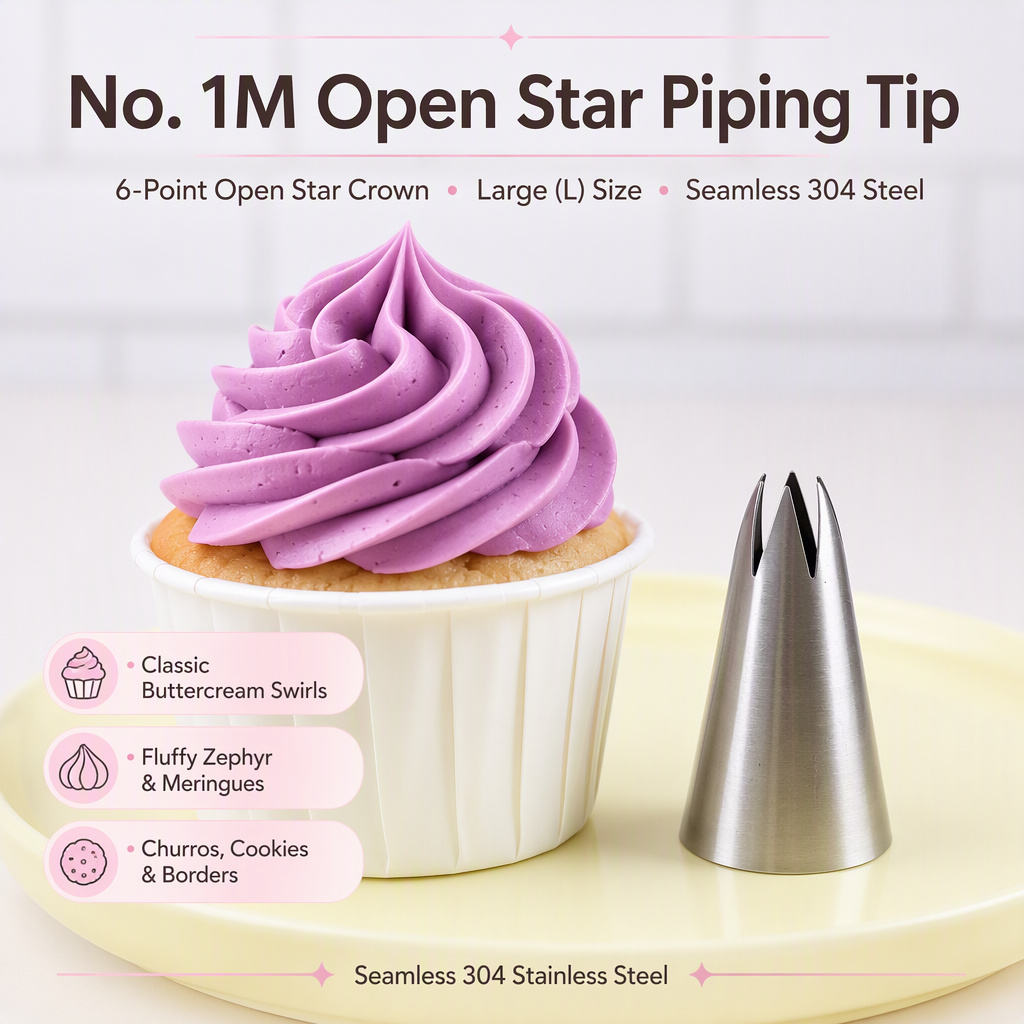
1M — open star
The 1M is an open star tip with a large base, which means it fits a large coupler rather than a standard one. One steady squeeze produces a six-point star; a continuous circular motion produces the classic rosette that fills cupcake tops and cake borders. Wilton credits senior decorator Marie Kason with developing the 1M in 1985. The company still describes it as its most popular decorating tip. That is why it is the number most often quoted in enquiries, even by buyers who use other brands.
2D — drop flower
The 2D is a drop flower tip: the grooves are partly closed, so the icing folds into petals as it leaves the opening. A single squeeze gives you a finished flower with no wrist work. It is the fastest route to a rosette-dense cake and the reason drop flower tips sell in sets rather than singly.
1A — large round
The 1A has a plain circular opening on a large base. It pipes large dots, thick outlines and fillings. It is also the tip most often substituted when a buyer wants a bigger version of a standard round tip. Because the opening is round, quality differences show up here first. An out-of-round opening produces a visible wobble in every line.
1G — drop flower, large
The 1G belongs to the large drop flower group alongside 1B, 1E, 1F, 2C and 2F. That family is where Russian-style single-squeeze flowers live. The differences inside the group are subtle: petal count, groove depth, how much the grooves close. But they change the finished flower enough that decorators keep several in the drawer.
233 — grass, multi-opening
The 233 is a multi-opening tip: several small holes rather than one shaped opening. It pipes grass, fur and hair texture, and Wilton calls it the most popular tip in its specialty category. It fits a standard coupler. Multi-opening tips are the hardest to manufacture consistently. Every hole has to be the same size, or the strands come out uneven.
104 — petal
The 104 is a petal tip with a narrow teardrop opening, and it is the standard choice for piping rose petals and ribbon borders. It fits a standard coupler. Petal tips are directional: the narrow end must face the direction of travel. A badly finished edge shows immediately as ragged petals.
352 — leaf
The 352 is a leaf tip with a V-shaped opening that produces upright or ruffled leaves depending on the angle you hold the bag. It fits a standard coupler. Leaf tips are a good test of edge finishing: any burr on the V shows up as a torn leaf edge on the very first squeeze.
How shape changes the result
The family matters more than the number. Round tips lay down a smooth bead. Star tips create ridges, and drop flower tips close those ridges into petals. Petal tips form a thin fan, while multi-opening tips split the flow into strands. A buyer who orders “a star tip” without a number usually wants ridges. A buyer who orders “1M” wants that specific ridge count and rosette height.
| Family | Opening | What it produces | Typical use |
|---|---|---|---|
| Round | Plain circle | Smooth bead, dots, lines | Lettering, outlines, filling |
| Star | Serrated ring | Ridged star, shells, rosettes | Cupcake swirls, borders |
| Drop flower | Partly closed serration | Finished flower in one squeeze | Rosettes, Russian-style flowers |
| Petal | Narrow teardrop | Thin curved fan | Rose petals, ribbons, ruffles |
| Leaf | V shape | Upright or ruffled leaf | Flower leaves, borders |
| Multi-opening | Several small holes | Strands | Grass, fur, hair texture |
Reading a request through this table takes ten seconds. It prevents most shape-related returns. The family tells you what the customer is trying to decorate, not just which part number they copied from an old invoice.
Standard versus large couplers: the mistake that causes returns
Tip numbers are grouped by coupler size, and the split is not intuitive. Wilton’s guide lists 1M as the only star tip in the large group. The large round tips are 1A and 2A. The rest of the large group covers 1D, 28, 402, 250, 252, 134, 234, 235, 123 to 127, 113, 115, 366, 2C, 2F, 1B, 1E, 1F and 1G. Everything from 104 and 352 to 233 and 32 fits a standard coupler.
This is where wholesale orders go wrong. A buyer assembles a set from numbers alone. The large tips do not seat in the standard couplers shipped with the bags. The whole shipment becomes a complaint. A coupler is two parts: a base that sits inside the bag and a ring that locks the tip in place. A large base simply will not pass through a standard ring. No amount of tightening fixes the fit. The fix is procedural, not technical. Confirm coupler size in writing for every large-base tip, and ship couplers matched to the tips rather than to the bags.
How to specify tip equivalents in a wholesale order
The most reliable specification is a three-part line item: the familiar number, the opening shape, and the measured outlet diameter. That combination survives translation, brand substitution and staff turnover.
Ask for a sample squeeze when the order is new. Photograph it next to a ruler, and keep the photo with the approved sample. Then state the coupler size explicitly, because the same number can be sold with different bases by different factories. Finally, confirm the material grade and the food-contact documentation before the deposit, not after production. For stainless nozzles that means the grade (304 versus 201) and the test report reference.
Our own piping nozzle range is built around this workflow. Mixed containers start at 12 pcs per SKU, so a distributor can test seven shapes without committing to a full carton of each. Standard leads run 5 to 15 working days. If you send us a photograph of the squeeze you need, we match the opening rather than guessing from a number.
Why equivalent beats identical
An equivalent tip does the same job; an identical tip is the same object. Buyers usually need the first and ask for the second, and the gap between them is where quality lives.
Two nozzles can share a number and differ in stainless grade, wall thickness, seam construction and edge finishing. A seamed nozzle has an internal joint where icing collects; a seamless one does not. Edge finishing decides whether a petal tip tears the icing or lays it flat. However, those differences do not appear in any numbering system. A specification that stops at the number cannot protect you.
The practical answer is to buy on the specification and use the number as a label. Specify grade, seamless construction, measured opening, coupler fit, and a documented squeeze test. Write those five into the purchase order line rather than into an email thread, so the requirement survives the next reorder. Suppliers who can answer all five in writing are the ones worth a second order.
FAQ
Are piping tip numbers the same across brands?
No. Numbers are brand-specific codes, and the same number can describe different geometries between manufacturers. Treat a number as a request for a shape, then confirm the opening and diameter before production.
Which coupler does the 1M need?
The 1M has a large base and needs a large coupler. Standard couplers will not seat it. The same applies to 1A, 2A, 1D, 28, 402, and the 1B to 1G drop flower group.
Can I order a mixed set with low minimums?
Yes — mixed containers are normal for assortment testing. Ours starts at 12 pcs per SKU, which lets a distributor validate seven shapes before committing to cartons of each.
What documentation should come with a food-contact nozzle?
A test report reference you can verify, the stainless grade, and confirmation of seamless construction. If a supplier cannot name the report, the material claim is unverified.
Next step: send us a photograph of the squeeze you need and we will match the opening — request a wholesale quote.